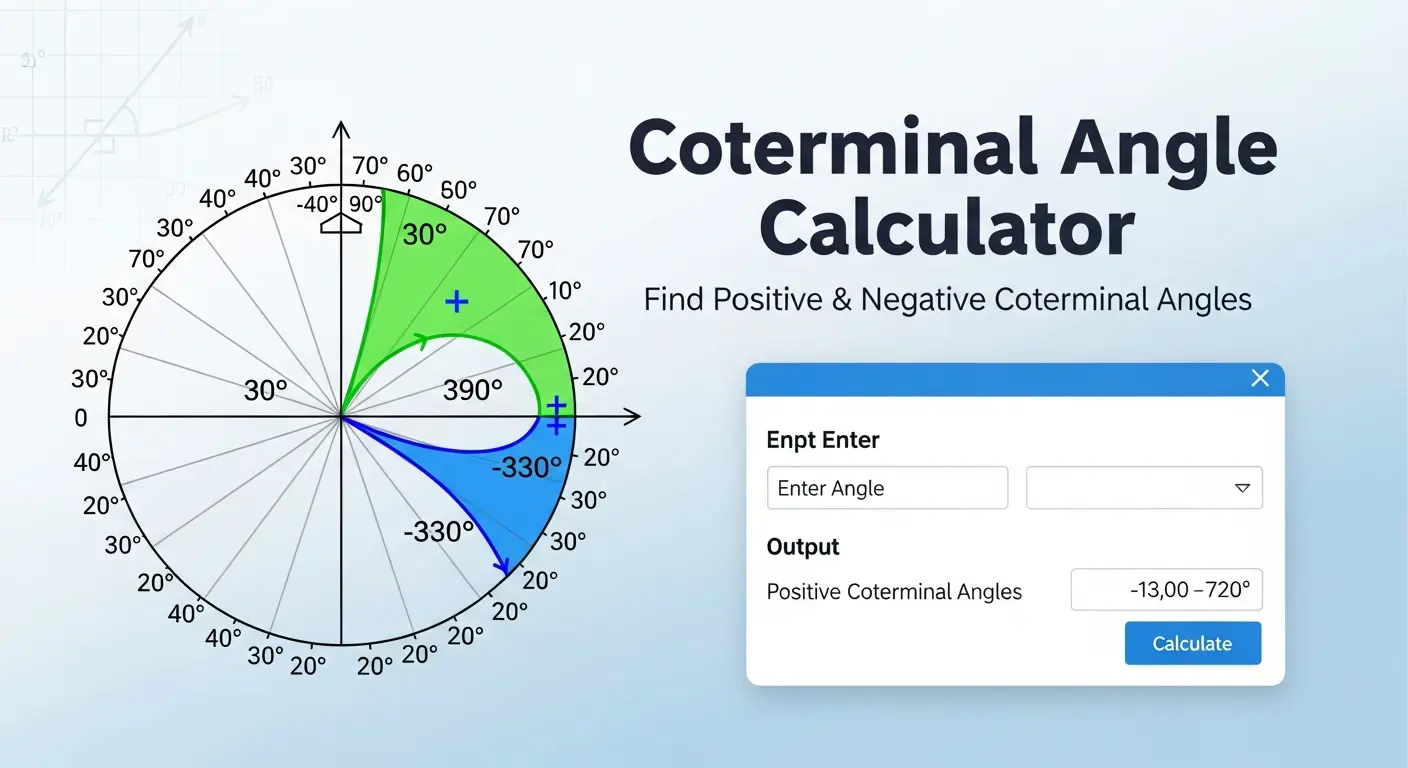
Coterminal Angle Calculator
Find Positive and Negative Coterminal Angles in Degrees and Radians
Calculate Coterminal Angles
Original Angle
Positive Coterminal Angles
Negative Coterminal Angles
📐 Formula Used
🔢 Step-by-Step Calculations
What Are Coterminal Angles?
Coterminal angles are angles that share the same terminal side when drawn in standard position on the coordinate plane. In other words, coterminal angles end at the same position despite having different degree or radian measures. This fundamental concept in trigonometry helps us understand angle relationships and simplify calculations.
Key Characteristics of Coterminal Angles
- Same Terminal Side: All coterminal angles terminate at the same position on the coordinate plane
- Differ by Full Rotations: Coterminal angles differ by multiples of 360° or 2π radians
- Equal Trigonometric Values: Coterminal angles have identical sine, cosine, and tangent values
- Infinite Possibilities: Every angle has infinitely many coterminal angles
- Positive and Negative: Coterminal angles can be both positive (counterclockwise) and negative (clockwise)
Real-World Examples
Consider a clock hand pointing at 3 o'clock (90°). If the hand makes one complete clockwise rotation and stops at 3 o'clock again, it's now at -270°. Both 90° and -270° are coterminal angles because they point in the same direction. Similarly, if the hand makes one complete counterclockwise rotation and stops at 3 o'clock, it's at 450° (90° + 360°).
This concept applies to wheels, gears, circular motion in physics, and navigation where understanding equivalent angular positions is crucial.
Coterminal Angle Formula
The formula for finding coterminal angles depends on whether you're working with degrees or radians. Both formulas follow the same principle: adding or subtracting complete rotations to the original angle.
Coterminal Angle Formulas
Formula in Degrees
θ ± 360° × n
Where θ is the original angle and n is any integer
Formula in Radians
θ ± 2π × n
Where θ is the original angle and n is any integer
Important Note: The variable n represents the number of complete rotations. Use positive values of n to find positive coterminal angles (counterclockwise rotation) and negative values of n to find negative coterminal angles (clockwise rotation).
Understanding the Formula Components
θ (Theta) - Original Angle
This is your starting angle, the angle for which you want to find coterminal angles. It can be any positive or negative value in degrees or radians.
360° or 2π - One Complete Rotation
A full rotation around the circle is 360 degrees or 2π radians. Adding or subtracting this value brings you back to the same terminal position.
n - Number of Rotations
An integer value representing how many full rotations to add (positive n) or subtract (negative n). Common values are 1, 2, -1, -2, but n can be any integer.
How to Find Coterminal Angles
Finding coterminal angles is a straightforward process that involves applying the appropriate formula based on your angle measurement unit. Follow these step-by-step methods to calculate coterminal angles accurately.
Identify the Angle
Start by identifying your original angle θ and determine whether it's measured in degrees or radians. This determines which formula you'll use.
Choose Positive or Negative
Decide whether you want positive coterminal angles (add full rotations) or negative coterminal angles (subtract full rotations).
Apply the Formula
Use θ + 360n (degrees) or θ + 2πn (radians) for positive angles. Use θ - 360n or θ - 2πn for negative angles, where n = 1, 2, 3, etc.
Calculate Multiple Angles
Continue with n = 2, 3, 4, etc., to find as many coterminal angles as needed. Each value of n gives you a different coterminal angle.
Detailed Example: Finding Coterminal Angles of 45°
Let's find positive and negative coterminal angles for θ = 45°
Finding Positive Coterminal Angles:
n = 1: 45° + 360°(1) = 45° + 360° = 405°
n = 2: 45° + 360°(2) = 45° + 720° = 765°
n = 3: 45° + 360°(3) = 45° + 1080° = 1125°
Finding Negative Coterminal Angles:
n = 1: 45° - 360°(1) = 45° - 360° = -315°
n = 2: 45° - 360°(2) = 45° - 720° = -675°
n = 3: 45° - 360°(3) = 45° - 1080° = -1035°
Working with Degrees and Radians
Coterminal angles can be calculated in both degrees and radians. Understanding how to work with both measurement systems is essential for solving trigonometry problems across different contexts.
Coterminal Angles in Degrees
When working with degrees, remember that one complete rotation equals 360°. This is the most common measurement system in everyday applications.
General Formula:
Coterminal = θ ± 360n
Example: θ = 120°
Positive: 120° + 360° = 480°
Negative: 120° - 360° = -240°
Coterminal Angles in Radians
In radians, one complete rotation equals 2π (approximately 6.28 radians). Radians are preferred in advanced mathematics and calculus.
General Formula:
Coterminal = θ ± 2πn
Example: θ = π/4
Positive: π/4 + 2π = 9π/4
Negative: π/4 - 2π = -7π/4
Conversion Between Degrees and Radians
Sometimes you may need to convert between degrees and radians when working with coterminal angles:
Degrees to Radians
radians = degrees × π/180
Radians to Degrees
degrees = radians × 180/π
Common Coterminal Angle Examples
Here are some frequently encountered coterminal angles that appear in trigonometry problems. Understanding these common examples helps build intuition for working with coterminal angles.
Reference Table of Coterminal Angles
| Original Angle | First Positive | First Negative | Second Positive |
|---|---|---|---|
| 30° | 390° | -330° | 750° |
| 45° | 405° | -315° | 765° |
| 90° | 450° | -270° | 810° |
| 180° | 540° | -180° | 900° |
| 270° | 630° | -90° | 990° |
| -45° | 315° | -405° | 675° |
Quick Tip: Notice that the difference between any original angle and its coterminal angles is always a multiple of 360°. This is the defining characteristic that makes angles coterminal.
Applications of Coterminal Angles
Understanding coterminal angles has practical applications across various fields including physics, engineering, navigation, and computer graphics. Here are some real-world scenarios where coterminal angles are essential.
Trigonometry & Calculus
Coterminal angles have identical sine, cosine, and tangent values, making them crucial for simplifying trigonometric equations and understanding periodic functions. They help reduce complex angles to equivalent angles within a standard range.
Physics & Engineering
Used to describe rotational motion, angular velocity, and periodic phenomena. Essential for understanding motors, gears, pendulums, and wave mechanics where angles repeat after complete rotations.
Navigation & GPS
航海 and aviation use coterminal angles to describe bearings and headings. When a compass bearing exceeds 360°, coterminal angles help normalize the direction to standard compass readings.
Computer Graphics
Animation and game development use coterminal angles to handle sprite rotation and camera movement. They ensure smooth transitions when objects rotate multiple times or move beyond 360°.
Astronomy
Celestial coordinates and orbital mechanics rely on coterminal angles to describe planetary positions, star locations, and satellite orbits that complete multiple revolutions around Earth or other celestial bodies.
Clocks & Time
Clock hands demonstrate coterminal angles perfectly. The hour hand at 3:00 (90°) occupies the same position as it would at 15:00 the next day (90° + 360°), showing real-world coterminal angle behavior.
Frequently Asked Questions
What are coterminal angles?
Coterminal angles are angles that share the same terminal side when drawn in standard position on the coordinate plane. They differ by multiples of 360 degrees or 2π radians. For example, 30° and 390° are coterminal angles because they end at the same position, with 390° having made one complete additional rotation.
How do you find coterminal angles?
To find coterminal angles, add or subtract multiples of 360° (for degrees) or 2π (for radians) from the original angle. The formula is θ ± 360n for degrees and θ ± 2πn for radians, where n is any integer. For positive coterminal angles, add full rotations; for negative ones, subtract full rotations.
What is the formula for coterminal angles?
The coterminal angle formula depends on the unit of measurement. For degrees: θ ± 360n. For radians: θ ± 2πn, where θ is the original angle and n is any integer (positive or negative). The ± symbol means you can either add or subtract to find different coterminal angles.
Can coterminal angles be negative?
Yes, coterminal angles can be negative. To find negative coterminal angles, subtract multiples of 360° or 2π from the original angle using negative values of n. For example, the negative coterminal angle of 45° is 45° - 360° = -315°. Negative angles represent clockwise rotation from the positive x-axis.
How many coterminal angles does an angle have?
Every angle has an infinite number of coterminal angles because you can add or subtract 360° (or 2π radians) any number of times. The value of n in the coterminal angle formula can be any integer from negative infinity to positive infinity, generating infinitely many coterminal angles.
Do coterminal angles have the same trigonometric values?
Yes, coterminal angles have identical trigonometric values. Since they share the same terminal side, their sine, cosine, tangent, and all other trigonometric functions produce the same results. This property makes coterminal angles particularly useful in simplifying trigonometric calculations.
How do you find the smallest positive coterminal angle?
To find the smallest positive coterminal angle (also called the principal angle), add or subtract 360° (or 2π) until you get a value between 0° and 360° (or 0 and 2π). If the angle is already in this range, it is the smallest positive coterminal angle. If negative, keep adding 360° until positive. If greater than 360°, keep subtracting 360° until within range.
What's the difference between coterminal and reference angles?
Coterminal angles share the same terminal side and differ by multiples of 360°, while reference angles are the acute angle (0° to 90°) formed between the terminal side and the x-axis. Coterminal angles can be any size, but reference angles are always between 0° and 90°. They serve different purposes in trigonometry.
Tips for Working with Coterminal Angles
Memorize Key Values
Remember that 360° = 2π radians = one complete rotation. This fundamental relationship is the foundation for all coterminal angle calculations and will speed up your work significantly.
Check Your Units
Always verify whether you're working in degrees or radians before applying the formula. Mixing units is a common mistake. Use 360n for degrees and 2πn for radians, never mix them in the same calculation.
Use the Calculator
Utilize our calculator above to verify your manual calculations and explore patterns. Seeing multiple coterminal angles at once helps develop intuition for how these angles relate to each other.
Visualize on Unit Circle
Drawing angles on a unit circle helps you understand why coterminal angles have the same trigonometric values. Visualizing the terminal side makes the concept much more intuitive and memorable.
Disclaimer: This coterminal angle calculator provides accurate results based on standard mathematical formulas. Results are calculated using θ ± 360n for degrees and θ ± 2πn for radians. For educational purposes, always verify critical calculations independently. This tool is designed to assist with homework, learning, and problem-solving in trigonometry.