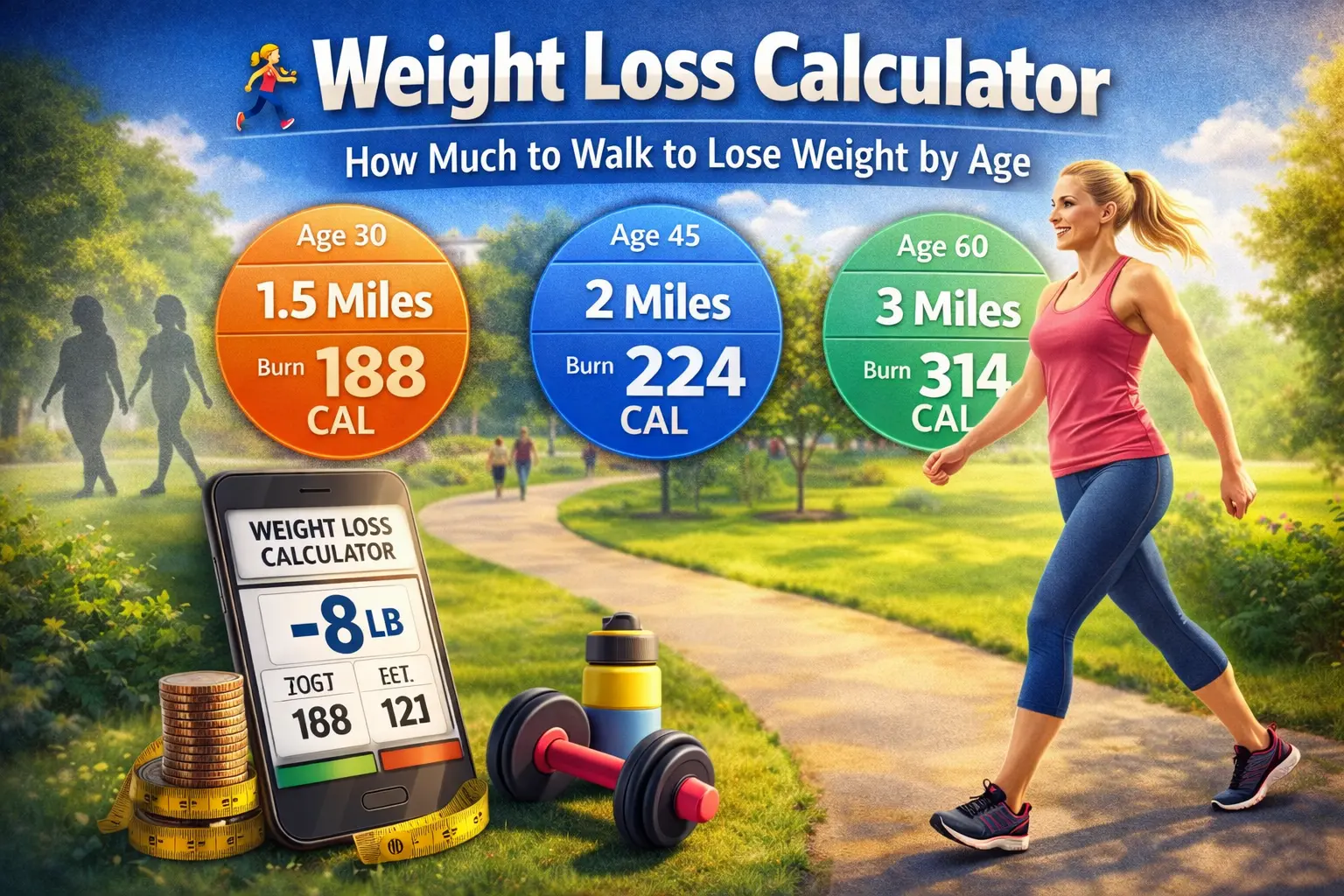
🏃♀️ Weight Loss Calculator - How Much to Walk to Lose Weight by Age
Science-based weight loss calculator! Get personalized recommendations for losing weight based on your age, height, weight, and fitness level. Calculate your daily calorie needs, walking distance required, steps target, and realistic timeline to reach your goal weight. Uses proven Mifflin-St Jeor equation and evidence-based weight loss science.
💪 Enter Your Information
📊 Your Personalized Weight Loss Plan
⏱️ Timeline to Goal Weight
🍽️ Daily Calorie Target
🚶♀️ Walking Requirements
📈 Progress Breakdown
📐 Weight Loss Calculation Formulas
1. BMR - Basal Metabolic Rate (Mifflin-St Jeor Equation)
For Men:
For Women:
Where: Weight in kg, Height in cm, Age in years
2. TDEE - Total Daily Energy Expenditure
Activity Multipliers:
- Beginner/Sedentary: 1.2
- Intermediate/Lightly Active: 1.375
- Advanced/Very Active: 1.55
3. Weight Loss Timeline
Note: 1 pound of fat ≈ 3,500 calories
4. Walking Calories Burned
Average: 0.04-0.05 calories per step
🎯 Healthy Weight Loss Rates by Age
| Age Range | Safe Rate (lbs/week) | Considerations | Notes |
|---|---|---|---|
| 18-30 | 1-2 lbs | Higher metabolism | Can tolerate aggressive approach |
| 31-40 | 1-1.5 lbs | Metabolism slowing | Focus on muscle preservation |
| 41-50 | 0.5-1.5 lbs | Hormonal changes begin | Strength training critical |
| 51-60 | 0.5-1 lb | Menopause (women), lower testosterone (men) | Slower, sustainable approach |
| 61+ | 0.5-1 lb | Muscle loss (sarcopenia) | Prioritize protein and exercise |
🔥 Daily Calorie Deficit Guide
| Daily Deficit | Weekly Loss | Method | Sustainability |
|---|---|---|---|
| 250 calories | 0.5 lbs | Diet only or light walking | Very sustainable, slow |
| 500 calories | 1 lb | Balanced diet + moderate exercise | Sustainable, recommended |
| 750 calories | 1.5 lbs | Lower calorie diet + daily exercise | Moderately challenging |
| 1000 calories | 2 lbs | Controlled diet + intense exercise | Challenging, maximum safe rate |
⚠️ Important Safety Guidelines
- Minimum calories: Never go below 1,200/day (women) or 1,500/day (men)
- Maximum loss: Do not exceed 2 lbs/week unless under medical supervision
- Consult doctor: Required before starting if you have health conditions
- Muscle preservation: Include strength training 2-3x per week
- Nutrition quality: Focus on whole foods, not just calorie counting
🚶 Walking Distance & Steps for Weight Loss
| Daily Steps | Distance | Time (moderate pace) | Calories Burned* |
|---|---|---|---|
| 5,000 steps | 2.5 miles | 45 minutes | 150-200 calories |
| 7,500 steps | 3.75 miles | 70 minutes | 225-300 calories |
| 10,000 steps | 5 miles | 90 minutes | 300-400 calories |
| 12,500 steps | 6.25 miles | 110 minutes | 375-500 calories |
| 15,000 steps | 7.5 miles | 135 minutes | 450-600 calories |
*Based on 150 lb person. Heavier individuals burn more calories.
📖 How to Use the Weight Loss Calculator
Step 1: Enter Accurate Information
- Height: Select feet and inches using dropdowns
- Current Weight: Enter today's weight in pounds
- Age: Your age in years (affects metabolism)
- Gender: Men and women have different BMR formulas
Step 2: Select Fitness Level
- Beginner (Sedentary): Little to no exercise, desk job
- Intermediate (Lightly Active): Light exercise 1-3 days/week
- Advanced (Very Active): Hard exercise 4-5 days/week
Step 3: Set Realistic Goal Weight
- Use BMI healthy range as guide (18.5-24.9)
- Consider body composition, not just scale weight
- Set incremental goals (lose 10 lbs, reassess, repeat)
Step 4: Review Results
- Timeline: How many weeks to reach goal at healthy rate
- Daily Calories: Target intake to create deficit
- Walking Plan: Steps, distance, time needed daily
- Expected Deficit: Calories below maintenance
❓ Frequently Asked Questions
For 1 lb/week loss, walk 10,000 steps daily + reduce diet by 200-300 calories.
The science:
- 1 pound of fat = 3,500 calories deficit needed
- 1 lb/week = 500 calorie daily deficit
- 10,000 steps = ~5 miles = 300-400 calories burned
- Remaining 100-200 calories from diet reduction
Walking alone (no diet change):
- To lose 1 lb/week: 12,500-15,000 steps daily
- To lose 2 lbs/week: 25,000-30,000 steps (unrealistic for most)
Best approach: Combine walking (60% of deficit) with diet modification (40% of deficit) for sustainable results.
Calculate TDEE, then subtract 500 calories for healthy loss.
Step-by-step:
- Calculate BMR using Mifflin-St Jeor equation
- Multiply by activity factor: Sedentary (1.2), Lightly Active (1.375), Very Active (1.55)
- This gives TDEE (maintenance calories)
- Subtract 500 for 1 lb/week or 1000 for 2 lbs/week
Example (5'5" woman, 180 lbs, age 40, sedentary):
- BMR = 1,447 calories
- TDEE = 1,447 × 1.2 = 1,736 calories
- Weight loss target = 1,736 - 500 = 1,236 calories
- But minimum is 1,200, so eat 1,200-1,300 calories
Never go below: 1,200 cal/day (women) or 1,500 cal/day (men) without medical supervision.
Yes, but only for those with significant weight to lose (30+ lbs).
Who can lose 2 lbs/week safely:
- People with BMI > 30 (obese category)
- Those with 50+ pounds to lose
- Younger individuals (18-40) with robust metabolism
- Under medical or professional supervision
Who should aim for 0.5-1 lb/week:
- BMI 25-30 (overweight category)
- Less than 20 pounds to lose
- Age 50+ (slower metabolism)
- History of yo-yo dieting
Risks of losing too fast:
- Muscle loss (decreases metabolism further)
- Nutritional deficiencies
- Gallstones
- Hair loss, fatigue
- Higher chance of regaining weight
Yes, metabolism decreases 2-5% per decade after age 30.
Why weight loss is harder with age:
| Factor | Impact | Solution |
|---|---|---|
| Muscle loss | 2-5% BMR decrease/decade | Strength training 2-3x/week |
| Hormonal changes | Slower fat burning | Medical consultation |
| Less activity | Lower TDEE | Increase daily movement |
| Slower recovery | Limits exercise intensity | Focus on consistency |
Age-based adjustments:
- Age 50+: Expect to eat 100-200 fewer calories than at age 30
- Slower rate: 0.5-1 lb/week instead of 1-2 lbs/week
- More protein: 25-30% of calories to preserve muscle
- Strength priority: Weights > cardio for metabolism
Approximately 70,000-87,500 steps to burn 1 pound of fat.
The math:
- 1 pound of fat = 3,500 calories
- Average person burns 0.04-0.05 calories per step
- 3,500 ÷ 0.04 = 87,500 steps
- 3,500 ÷ 0.05 = 70,000 steps
Timeline at different daily steps:
| Daily Steps | Days to Lose 1 lb | Weekly Loss |
|---|---|---|
| 5,000 | 14-17 days | 0.4-0.5 lbs |
| 10,000 | 7-9 days | 0.8-1 lb |
| 15,000 | 5-6 days | 1.2-1.4 lbs |
Important: This assumes no diet change. Combining walking with calorie reduction doubles effectiveness!
Yes! 30 minutes daily = 0.25-0.5 lbs/week when combined with diet.
30 minutes of brisk walking burns:
- At 3 mph (moderate): 120-150 calories
- At 4 mph (brisk): 150-180 calories
- Steps: 3,000-4,000 steps
Weekly impact:
- 7 days × 150 calories = 1,050 calories burned
- 1,050 ÷ 3,500 = 0.3 lbs from walking alone
- Add 200-300 calorie diet reduction = 0.5-0.8 lbs total weekly loss
To maximize 30-minute walks:
- Walk briskly (3.5-4 mph, able to talk but not sing)
- Include hills or incline to burn 50% more calories
- Walk after meals to improve blood sugar control
- Be consistent - daily is better than sporadic long walks
📚 Official Weight Loss & Health Resources
Government & Medical Organizations:
- CDC - Losing Weight - Official healthy weight loss guidelines
- NIH - Weight Management - Evidence-based weight loss information
- WHO - Obesity Facts - Global obesity and weight guidelines
- American Heart Association - Heart-healthy weight loss
Nutrition & Exercise Standards:
- Academy of Nutrition and Dietetics - Professional nutrition guidance
- American College of Sports Medicine - Exercise recommendations
- USDA Nutrition - Dietary guidelines for Americans